Textile major work
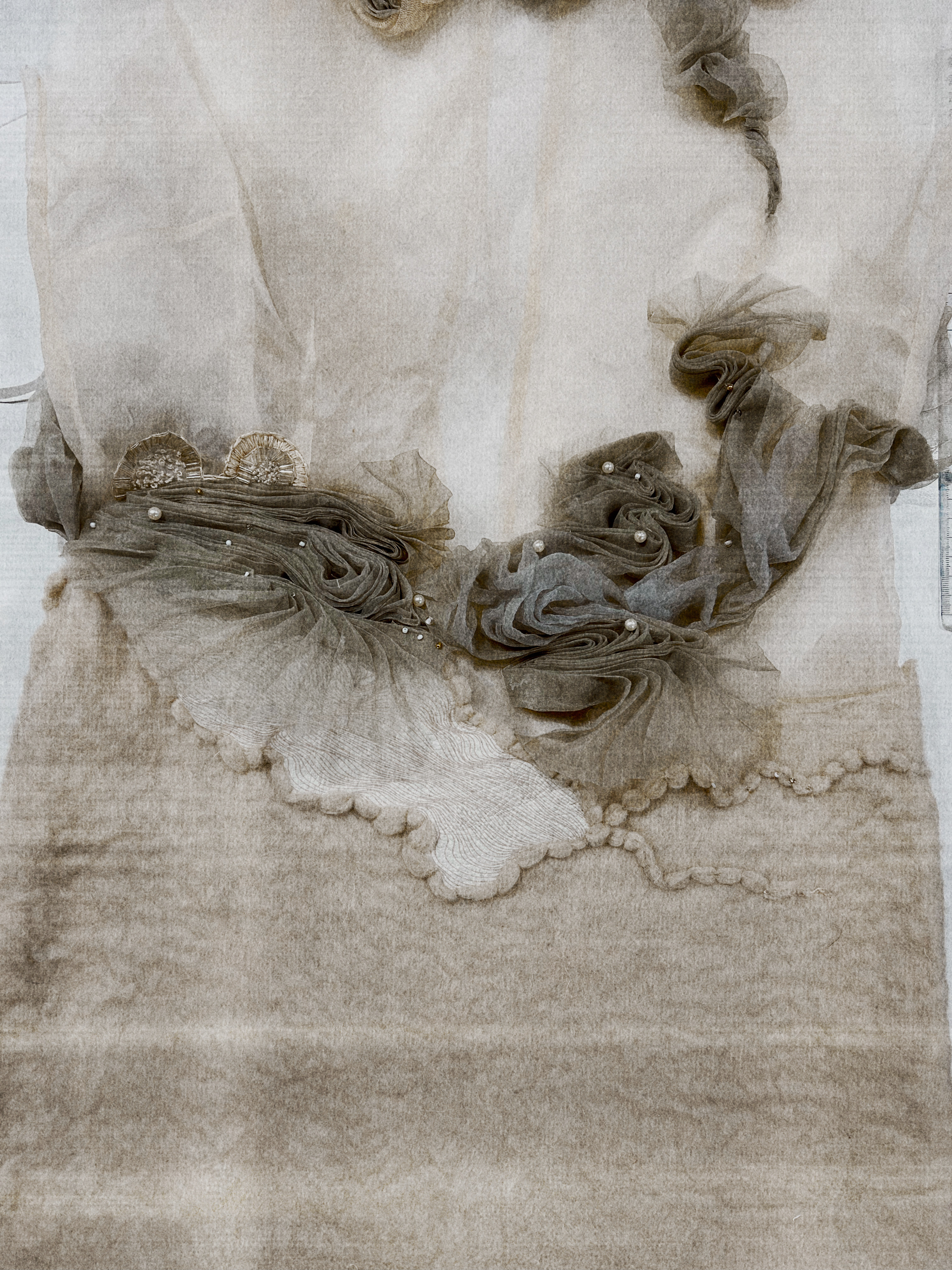
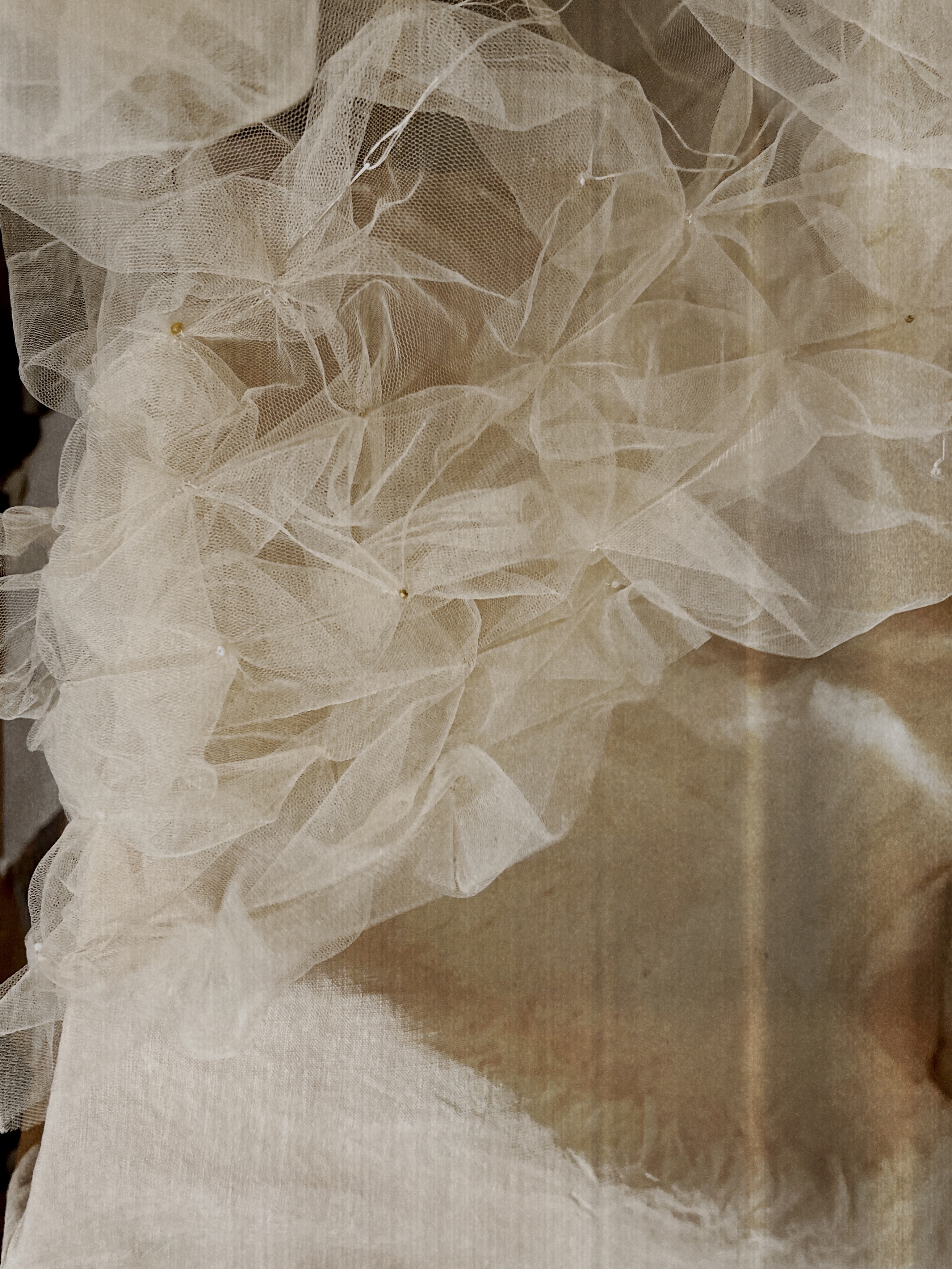
Selected best in state NSW 2023
The Natura Architectus Dress
A wearable textile artwork: a sheer silk and organza gown with a fitted corset, designed to be worn by a young woman at the RAW TO A T event at Melbourne Fashion Festival. The event is run with Ethical Clothing Australia and promotes sustainable fashion and fair treatment of garment workers, so every choice in the brief had to be both beautiful and responsible. I treated the project the way a UX designer treats a product: define who it is for, test every decision, and prove each one with evidence.
The idea behind it is called disintegration of structure. Roman buildings like the Colosseum were eroded by weather and absorbed back into the natural landscape. I wanted a garment that holds the same tension between built structure and organic form.
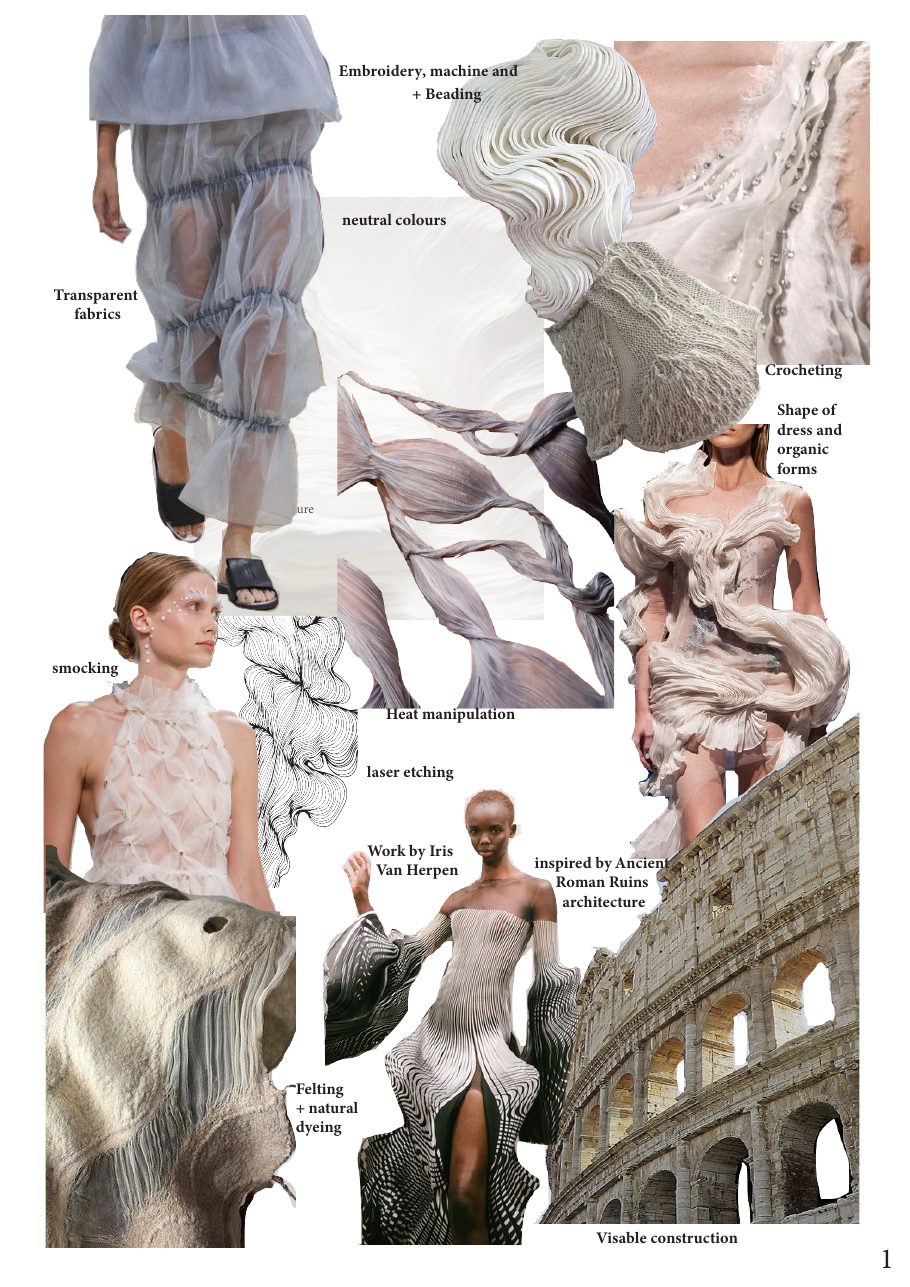
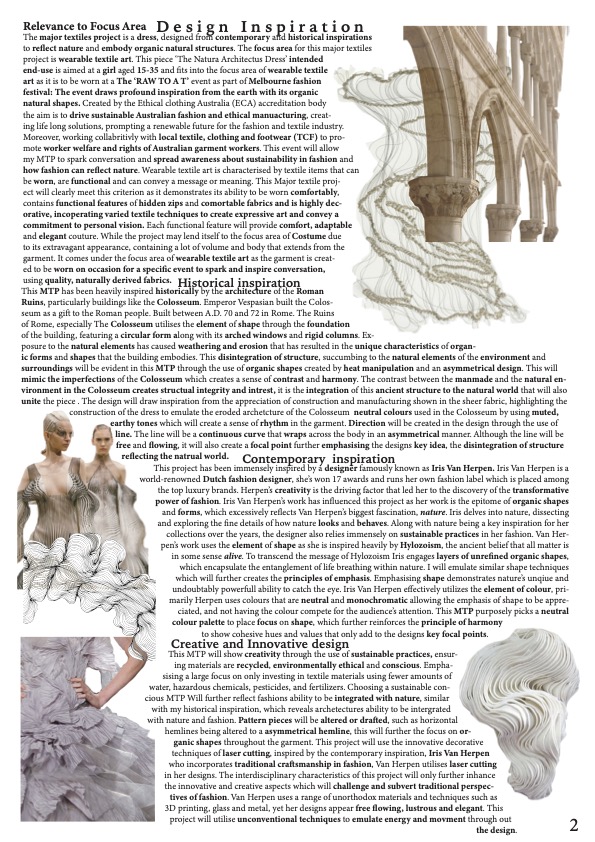
Research
Two sources drove the work. Historically, the Colosseum: its circular form, arched windows and rigid columns, and the way erosion left it imperfect. Contemporary, the Dutch designer Iris van Herpen, whose organic shapes, neutral palette and use of laser cutting and sustainable practice showed how nature can lead a collection. Together they set the colour scheme (muted, earthy neutrals so shape stays the focal point) and the principles I designed against: shape, line, emphasis and harmony.
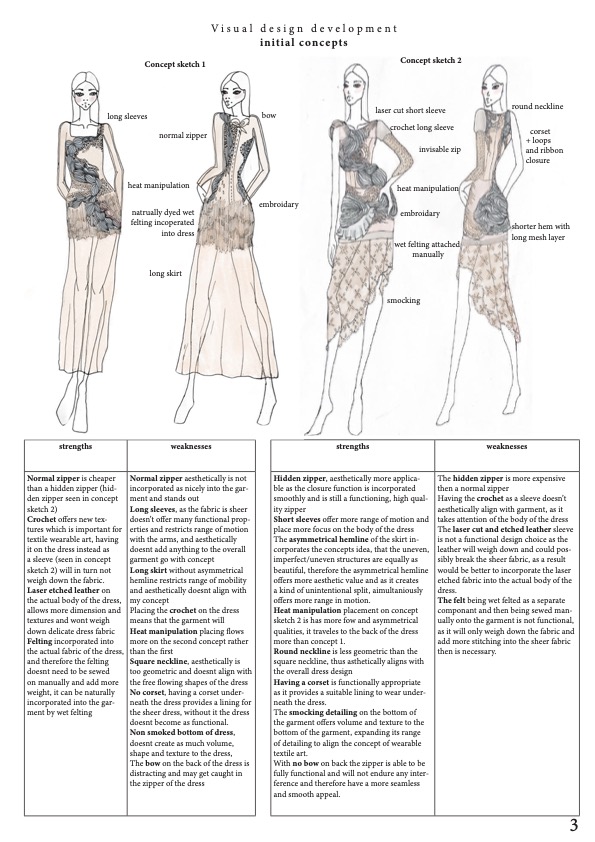
Concepts and critique
I sketched two concepts and tested each against the end use. Concept 1 had a normal zipper, long sleeves and a square neckline. These felt too geometric, and the long sleeves restricted movement. Concept 2 had short sleeves, a round neckline, a hidden zipper, a corset lining and an asymmetrical hemline. Its heat manipulation also travelled to the back of the dress, which gave it more flow. Writing out strengths and weaknesses for both meant the final design came from reasoning, not preference.
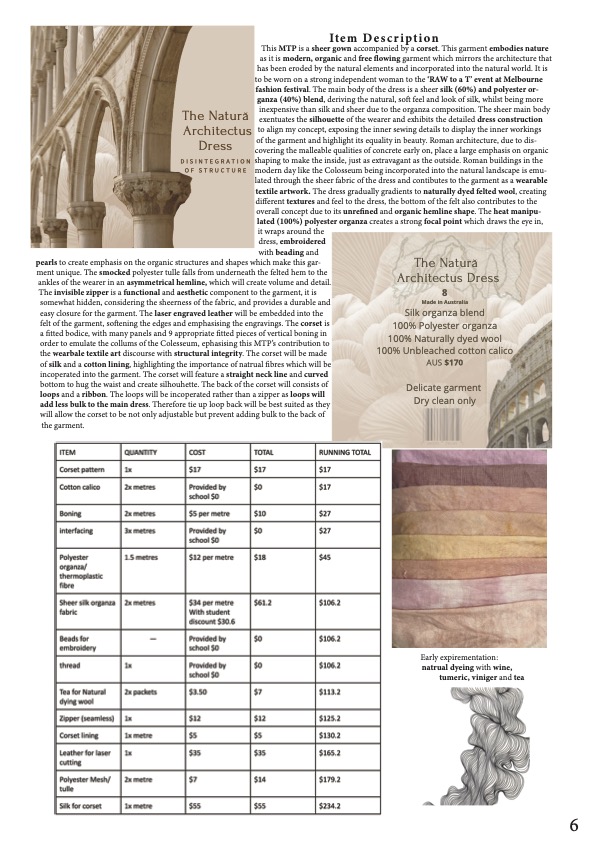
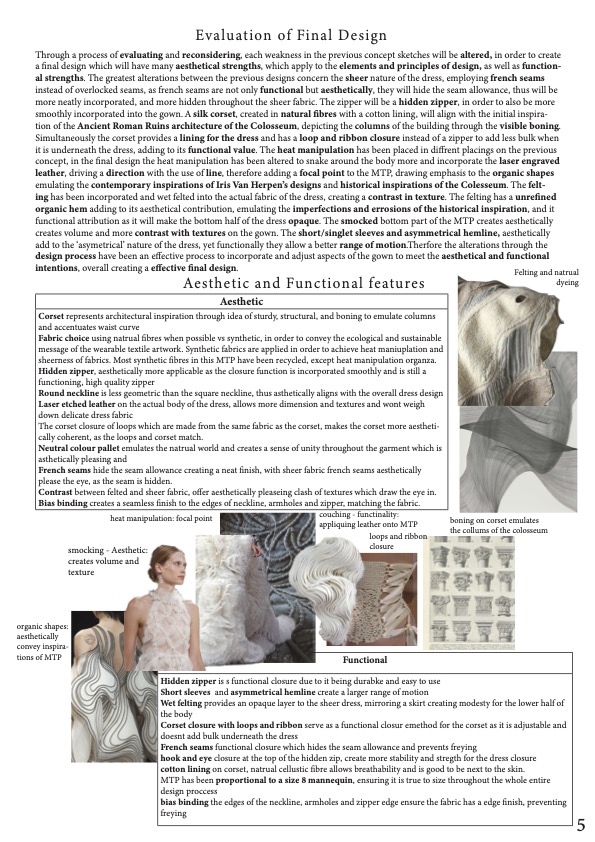
Final design
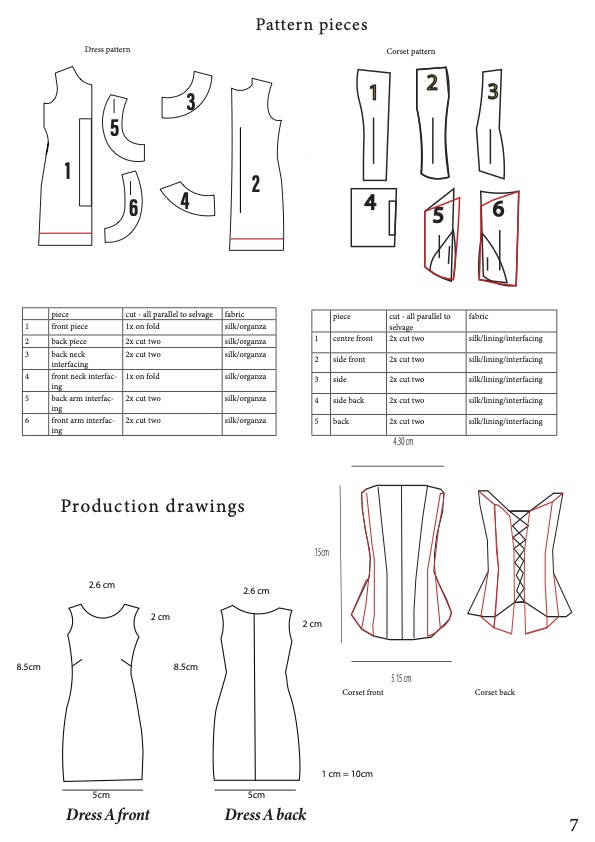
The final dress combines the strongest parts of both concepts. Heat-manipulated organza snakes around the body to create a focal point and direction. Laser-engraved leather is appliqued onto the dress. A wet-felted hem, dyed naturally, fades from sheer to opaque and gives an unrefined, eroded edge. The smocked skirt adds volume and texture. Under it all sits a silk corset with visible boning that echoes the Colosseum's columns, closed with custom fabric loops and a ribbon so it adds no bulk. Each feature is listed as aesthetic or functional on the evaluation page, because the dress had to work as wearable art, not just look like it.
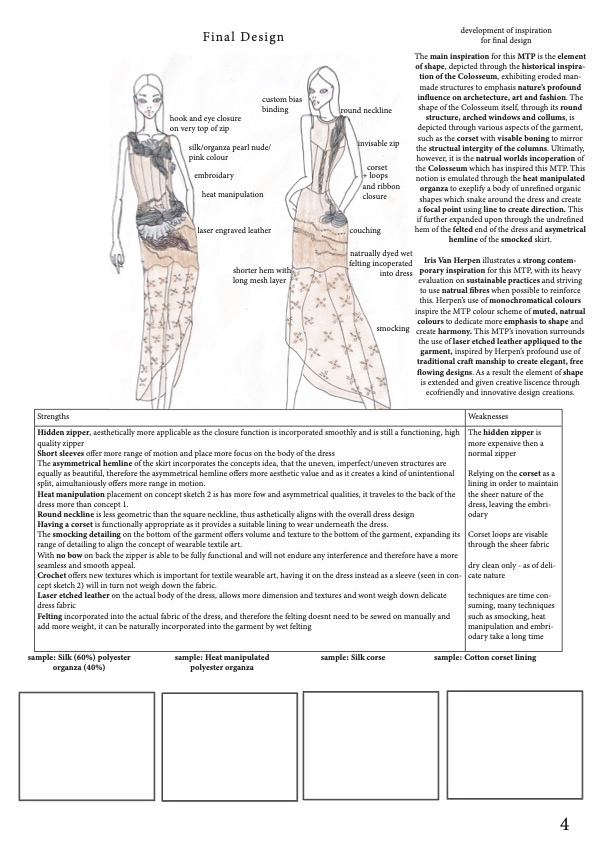
Materials and cost
The main body is a 60% silk, 40% polyester organza blend: the soft look of silk at lower cost, with the sheerness of organza. The heat-manipulated layer is 100% polyester organza, because thermoplastic fibres hold a shape. Most synthetic fibres are recycled, the felt is natural wool, and the corset lining is cotton. I costed every item, from the corset pattern to the leather, and ended with a running total of $234.20. I also designed a swing tag with care instructions (delicate, dry clean only) so the garment reads as a finished product.
Making it repeatable
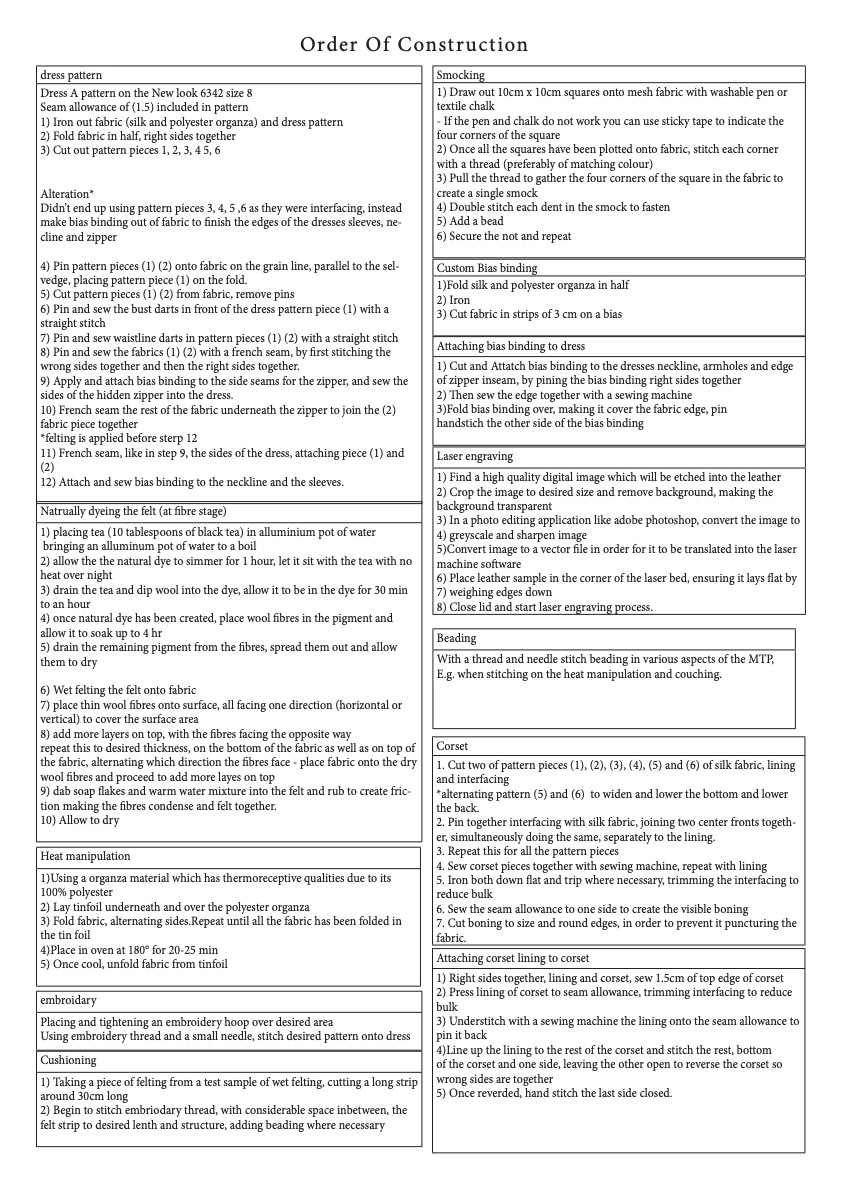
I wrote the whole build as numbered steps: pattern pieces and cutting layouts for the dress (adapted from a size 8 New Look pattern) and a custom corset, then step-by-step methods for heat manipulation, smocking, laser engraving, wet felting, natural dyeing, embroidery, couching and beading. Anyone could follow these to reproduce the dress. It was also how I checked the order of work, for example that felting happens before the bias binding.
Testing before committing
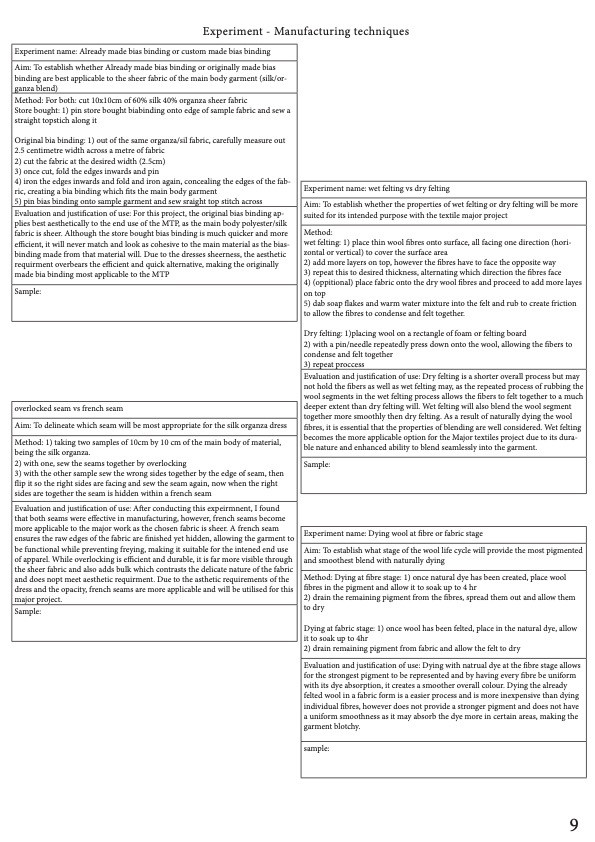
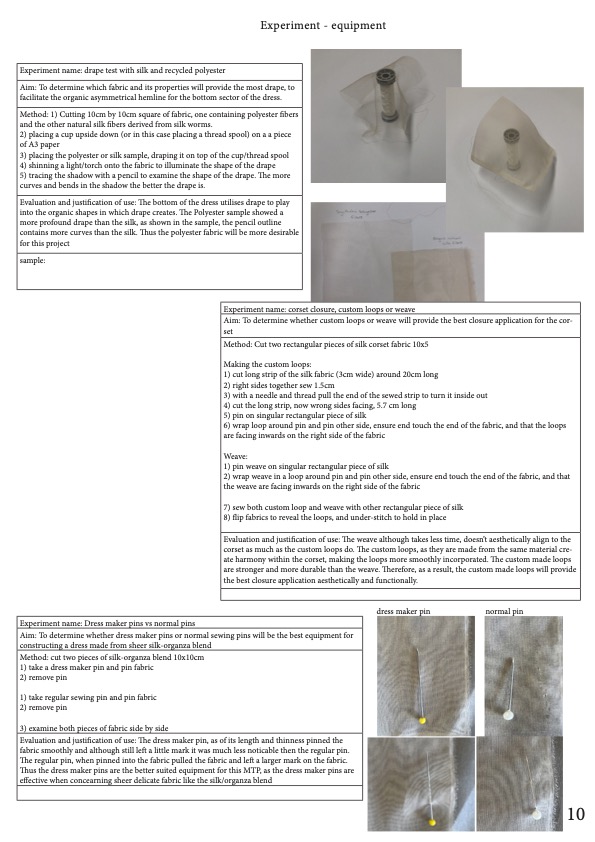
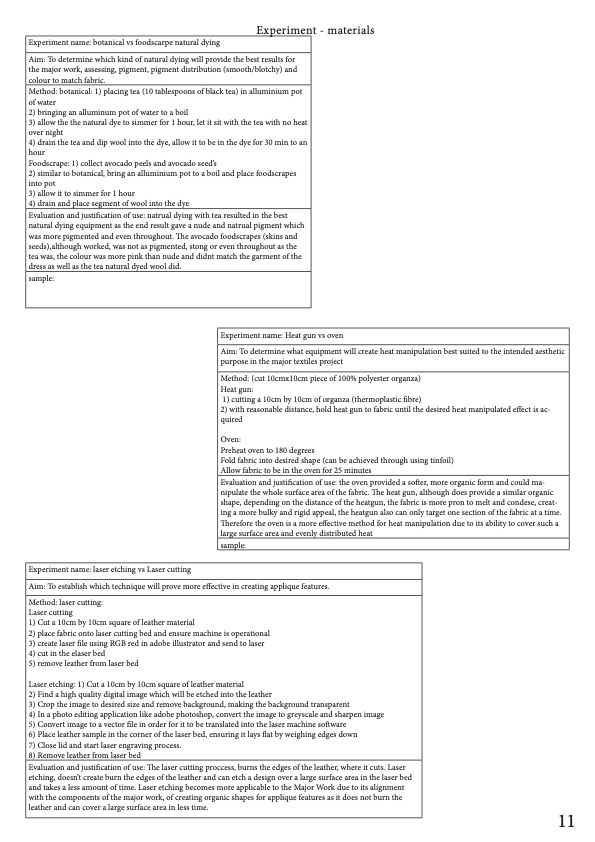
Every uncertain decision became a small experiment on a 10cm sample, with an aim, a method and a justified result. They worked like usability tests:
- French seams over overlocking, because overlocking showed through the sheer fabric.
- Wet felting over dry felting, for stronger bonding and a smoother blend.
- Dyeing wool at fibre stage, because it gave a stronger and more even colour than dyeing finished felt.
- Black tea over avocado scraps, giving a nude tone that matched the dress.
- Oven over heat gun for heat manipulation, since it shaped the whole fabric softly without melting.
- Laser etching over cutting, because it did not burn the leather edges.
- Custom loops over a woven closure, and dressmaker pins over standard pins, to protect the sheer fabric.
Outcome
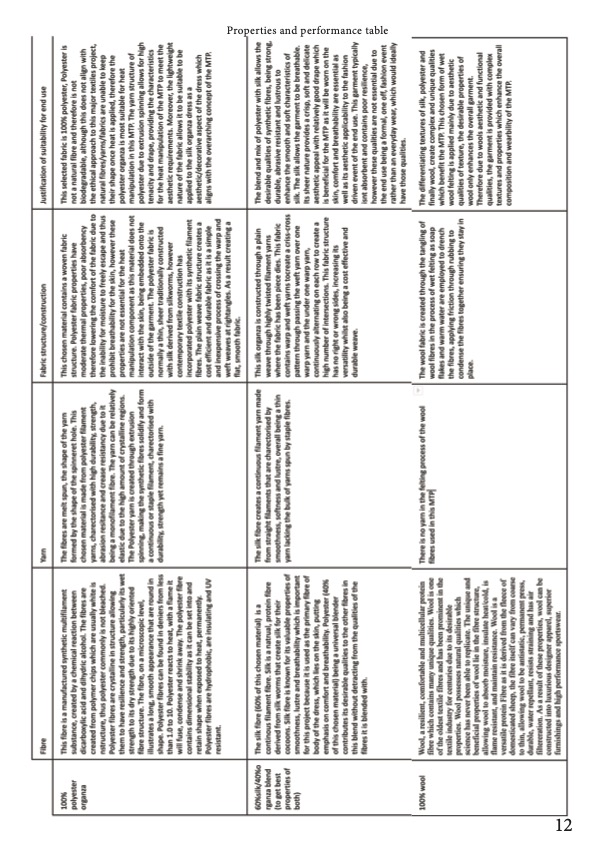
The final page compares polyester organza, the silk blend and wool by fibre, yarn, structure and suitability. It shows why each material earned its place. The project was selected as best in state for NSW in 2023. What I took from it is a way of working I now use in digital design: research the context, test options against the real end use, and be able to explain every decision.