As the excessive heat and energy warms the ocean, the change in temperature leads to unparalleled cascading effects, including ice-melting, sea-level rise, marine heatwaves, and ocean acidification.
These changes ultimately cause a lasting impact on marine biodiversity, and the lives and livelihoods of coastal communities and beyond - including around 680 million people living in low-lying coastal areas, almost 2 billion who live in half of the world’s megacities that are coastal, and nearly half of the world’s population that depends on fish for protein.
Here are some of the major consequences of the impacts of climate change on the ocean.
Sea-level rise
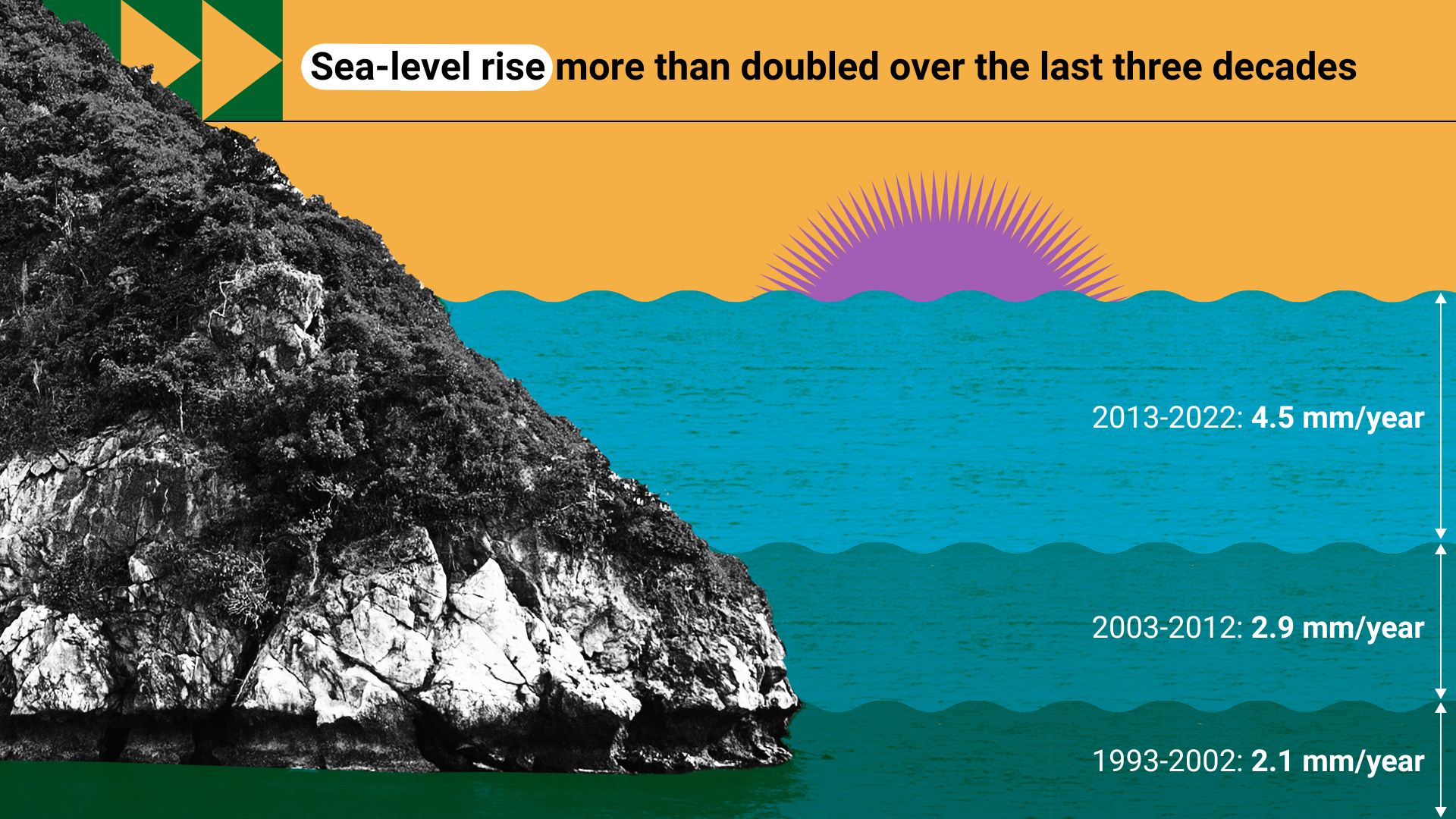
Sea-level rise has accelerated in recent decades due to increasing ice loss in the world’s polar regions. Latest data from the World Meteorological Organization shows that global mean sea-level reached a new record high in 2023, rising an average of 4.77 millimeter per year over the period 2014 to 2023.
Together with intensifying tropical cyclones, sea-level rise has exacerbated extreme events such as deadly storm surges and coastal hazards such as flooding, erosion and landslides, which are now projected to occur at least once a year in many locations.
Marine heatwaves
Marine heatwaves have doubled in frequency, and have become longer-lasting, more intense and extensive. The IPCC says that human influence has been the main driver of the ocean heat increase observed since the 1970s.
The majority of heatwaves took place between 2006 and 2015, causing widespread coral bleaching and reef degradation. The UN Environment Programme says that every one of the world’s coral reefs could bleach by the end of the century if the water continues to warm.
Loss of marine biodiversity
Rising temperatures increase the risk of irreversible loss of marine and coastal ecosystems. Today, widespread changes have been observed, including damage to coral reefs and mangroves that support ocean life, and migration of species to higher latitudes and altitudes where the water could be cooler.
Latest estimates warn that more than half of the world’s marine species may stand on the brink of extinction by 2100. A warming of 1.5°C threatens to destroy 70 to 90 percent of coral reefs, and a 2°C increase means a nearly 100 percent loss - a point of no return.