What
Happened
"Comfort women" — ianfu in Japanese, wianbu in Korean — is the euphemism the Japanese military used for women it conscripted into sexual slavery to service its troops between 1932 and 1945. The word comfort hides one of the most systematic atrocities of the Second World War.
opened in Shanghai
enslaved total
Korean victims
rate by war's end
How it began
The Japanese military "comfort station" system began in 1932 following the first Shanghai Incident, when the Japanese Army established the first organized facilities to provide sexual services to soldiers. Military commanders argued the system would reduce random rape of local civilians — which was damaging relations with occupied populations — and prevent the spread of venereal disease among troops.
What began as a limited program rapidly expanded as Japan's military campaigns spread across Asia. By the early 1940s, comfort stations existed in China, the Philippines, Indonesia, Burma, Malaya, Thailand, Vietnam, and across the Pacific Islands — wherever Japanese forces were stationed.
How women were recruited
The methods of recruitment varied but consistently involved deception, coercion, or outright abduction. In Korea — then a Japanese colony — women were commonly lured with promises of factory work, nursing jobs, or domestic service. Recruiters, often working as agents for the military, would approach poor rural families and offer signing fees.
Others were taken by force. Japanese police and soldiers conducted raids on villages. Girls as young as 12 and 13 were taken from their homes. Families who resisted faced violence. In some cases, women were taken directly from their workplaces or schools.
Once transported — to Manchuria, to Southeast Asia, to the Pacific — women found themselves in comfort stations with no money, no documentation, and no way home. The "contracts" many had unknowingly signed were used to justify keeping them in debt bondage.
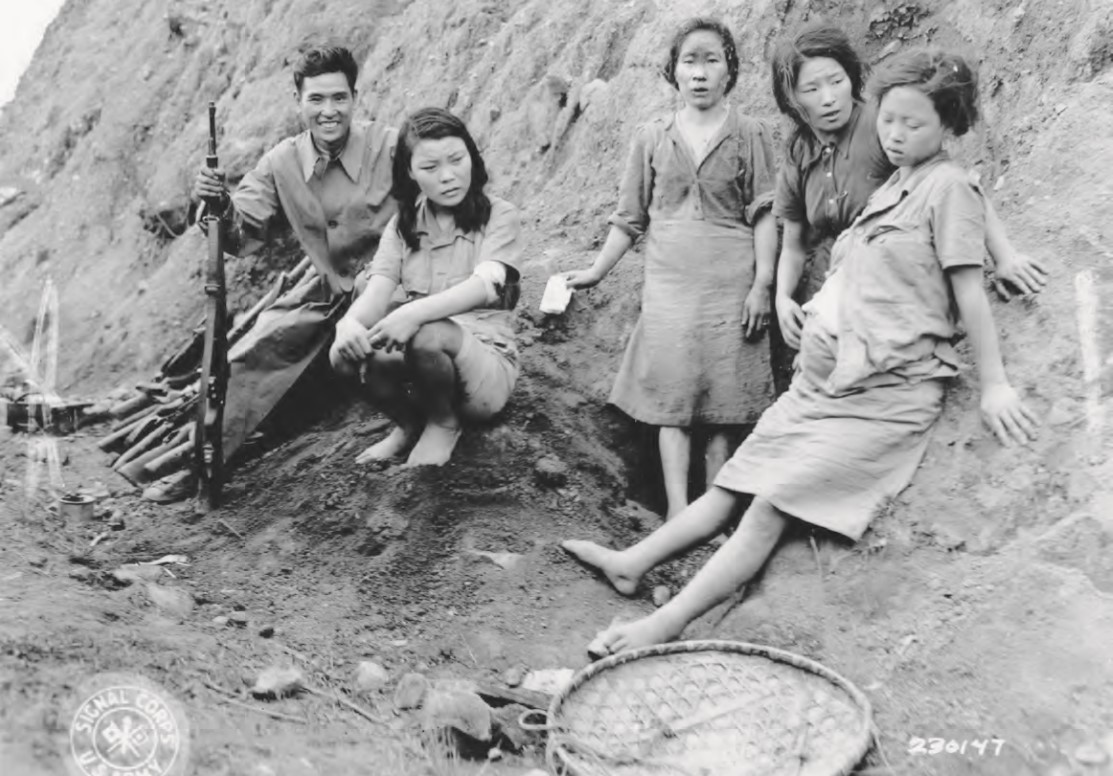
Korean comfort women survivors photographed near Songshan, China, 1944. Source: US National Archives.
Conditions inside the comfort stations
Life inside the comfort stations was one of extreme violence and degradation. Women were forced to service between 10 and 30 soldiers per day. They were given Japanese names and stripped of their Korean identities. Movement was restricted. Resistance was punished with beatings.
Women who became pregnant were typically forced to have abortions or were killed. Those who contracted sexually transmitted diseases were given injections of the highly toxic drug Salvarsan — sometimes as punishment, sometimes in attempts to keep them "functional." Many women were left permanently unable to have children.
As the war turned against Japan and supply lines collapsed, conditions worsened dramatically. Women in remote stations were sometimes simply abandoned when troops retreated. Others were killed to prevent them from testifying.
The scale and geography
Historians estimate the total number of women enslaved in the comfort station system at between 50,000 and 200,000 — the uncertainty itself reflecting how systematically records were destroyed as Japan surrendered. Approximately 80% were Korean, with the remainder drawn from China, the Philippines, Taiwan, Indonesia, the Netherlands, and other occupied territories.
The survival rate was devastatingly low. Some estimates suggest that fewer than 25% of comfort women survived the war. Those who did survive faced years of trauma, social stigma, and silence — in many cases unable to speak of what had happened even to their own families.
The cover-up
In the final weeks of the war, Japanese military command issued orders to destroy documentation related to the comfort station system. Records were burned. Witnesses were dispersed. When the American occupation began and war crimes trials were convened, the comfort women system was largely overlooked — in part because American prosecutors were focused on other atrocities, and in part because the system's victims were colonial subjects whose suffering carried less political weight.
For nearly five decades, the story was effectively buried. Japanese textbooks made no mention of it. Korean survivors were too ashamed, too traumatized, or too afraid of social consequences to speak. The silence held until 1991.