Their
Voices
For 46 years, the survivors were silent. Then, on August 14, 1991, Kim Hak-soon stood in front of a microphone and told the truth. What followed changed history.
Kim Hak-soon — the woman who broke the silence
Kim Hak-soon was 67 years old when she became the first comfort woman survivor to publicly identify herself and testify about what had been done to her. She had carried the secret for 46 years.
She had been taken from her home at 17, deceived into believing she was being taken to work. She was brought to a comfort station in China. When the war ended she made her way back to Korea, where she spent decades in poverty and silence — too ashamed, she said, to tell even her own children.
Her decision to speak was prompted by a Japanese academic publishing research that denied the existence of the system entirely. She could no longer stay quiet.
"I am speaking because I want the Japanese government to admit what was done to us and apologize. Not money. An apology. I want them to say: this happened, it was wrong, and we are sorry."
— Kim Hak-soon, press conference, Seoul, August 14, 1991Her testimony triggered an outpouring. Within months, hundreds of other Korean survivors came forward. Testimonies emerged from survivors in the Philippines, Taiwan, Indonesia, and the Netherlands. The Japanese government, facing an avalanche of evidence it could no longer ignore, acknowledged the system for the first time in 1993.
More survivors speak
"I was sixteen when they took me. They said I would learn to be a nurse. On the ship I realized where I was going. When I tried to resist I was beaten. I was a comfort woman for three years in China and Burma. When the war ended I had no money, no documents, and I did not know where I was."
— Lee Ok-seon, b. 1927. Testimony to the Korean Council, 1993."My mother cried when I left because the recruiter offered money we needed badly. She thought I was going to work in a factory. I never blamed her. How could she have known? I never told her what really happened. I let her believe the factory story until she died."
— Survivor testimony. Name withheld at request. Korean Council archive, 1994."After the war I came home but I could not tell anyone. Who would marry me? Who would hire me? I had a child — the child of a Japanese soldier — and I gave her away because I could not keep her and live in my village. I have been looking for her my whole life."
— Survivor testimony. Korean Council for Justice and Remembrance archive.The Wednesday Demonstrations
On January 8, 1992, a small group of survivors and activists gathered outside the Japanese Embassy in Seoul to demand an official apology. They called it the Wednesday Demonstration. They said they would come back every Wednesday until Japan acknowledged what had happened.
They have come back every Wednesday since. As of 2024, the Wednesday Demonstration has been held over 1,800 times — making it the longest continuously running weekly protest in recorded history.
In the early years, survivors attended themselves — some in wheelchairs, some barely able to stand. As they died one by one, younger activists, students, and descendants took their places. The demonstration is now both a memorial and a living act of resistance.
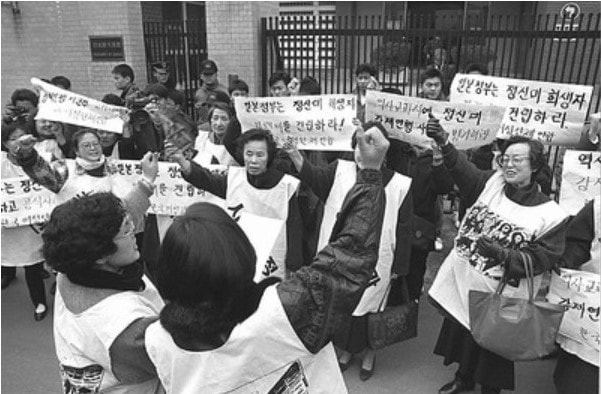
Wednesday Demonstration participants outside the Japanese Embassy, Jongno-gu, Seoul. The demonstration has continued without interruption since January 8, 1992.
The Peace Girl statue — 평화의 소녀상
On December 14, 2011 — the 1,000th Wednesday Demonstration — a bronze statue of a young girl was installed directly across the street from the Japanese Embassy in Seoul. Created by sculptors Kim Eun-sung and Kim Seo-kyung, the statue depicts a teenage girl in traditional Korean clothing, sitting barefoot with her fists clenched in her lap, an empty chair beside her.
The empty chair is for visitors to sit in — to sit beside her, in solidarity.
The Japanese government demanded the statue be removed. The South Korean government declined. The statue became a global symbol: replicas now stand in Germany, the United States, Australia, Canada, and across Asia. Each time Japan has pressured a country to remove one, the demand has generated more attention, more coverage, and more replicas.
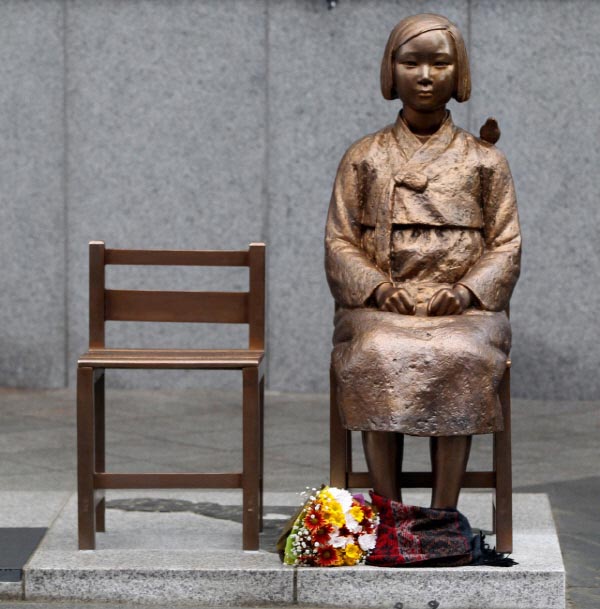
The Peace Girl statue, installed December 14, 2011, across from the Japanese Embassy in Jongno-gu, Seoul. Sculptor: Kim Eun-sung and Kim Seo-kyung.
The survivors today
Of the 240 Korean survivors who registered with the South Korean government after 1992, fewer than ten remain alive as of 2024. The youngest are in their late 80s. Most have spent their final decades doing what seemed unimaginable in 1945: speaking publicly, testifying before legislatures, filing lawsuits, accepting awards, and refusing to let the world forget.
Lee Yong-soo, now in her 90s, has testified before the US Congress, the European Parliament, and the United Nations. Gil Won-ok, who died in 2022 at age 96, attended Wednesday Demonstrations into her final years. Their persistence represents one of the most remarkable acts of sustained advocacy in modern history.