Remember.
Act.
August 14th is the International Day of Comfort Women — the anniversary of Kim Hak-soon's 1991 testimony. The survivors are nearly all gone. Their memory, and the justice they never fully received, now belongs to everyone who knows the story.
Why this still matters now
Wartime sexual violence is not a historical problem. It is a current one. The same patterns — the systematic use of sexual violence as a tool of war and occupation, the silencing of survivors, the denial of state responsibility — have been documented in Bosnia, Rwanda, the Democratic Republic of Congo, Myanmar, and in the ongoing conflict in Ukraine.
The comfort women's struggle for recognition was one of the first times in history that survivors of wartime sexual slavery successfully forced the issue onto the international stage. Their activism changed international law: the Rome Statute of the International Criminal Court, adopted in 1998, explicitly defines systematic rape and sexual slavery as crimes against humanity and war crimes — in large part because of the attention the comfort women movement brought to these issues.
How the world responds to their unfinished case sends a signal about how seriously it takes that law.
Memorials around the world
Peace Girl statues and comfort women memorials now stand in over a dozen countries. Each one represents a local community choosing to remember — often over the objections of the Japanese government.
- 🇰🇷 Seoul, South Korea — The original Peace Girl statue, installed across from the Japanese Embassy on December 14, 2011. The site of the Wednesday Demonstration every week since 1992.
- 🇺🇸 Glendale, California — The first Peace Girl statue installed outside of Korea, 2013. Japan lobbied for its removal. A US federal court ruled it could stay.
- 🇩🇪 Berlin, Germany — A Peace Girl statue installed in Mitte in 2020. Japan pressured the Berlin Senate to remove it. After a prolonged campaign by Korean and German activists, it was granted permanent status in 2022.
- 🇦🇺 Sydney, Australia — A memorial in Ashfield, Sydney, installed in 2016. One of the largest Korean diaspora communities outside Korea.
- 🇨🇦 Toronto, Canada — A memorial in the Toronto Korean community, installed 2015.
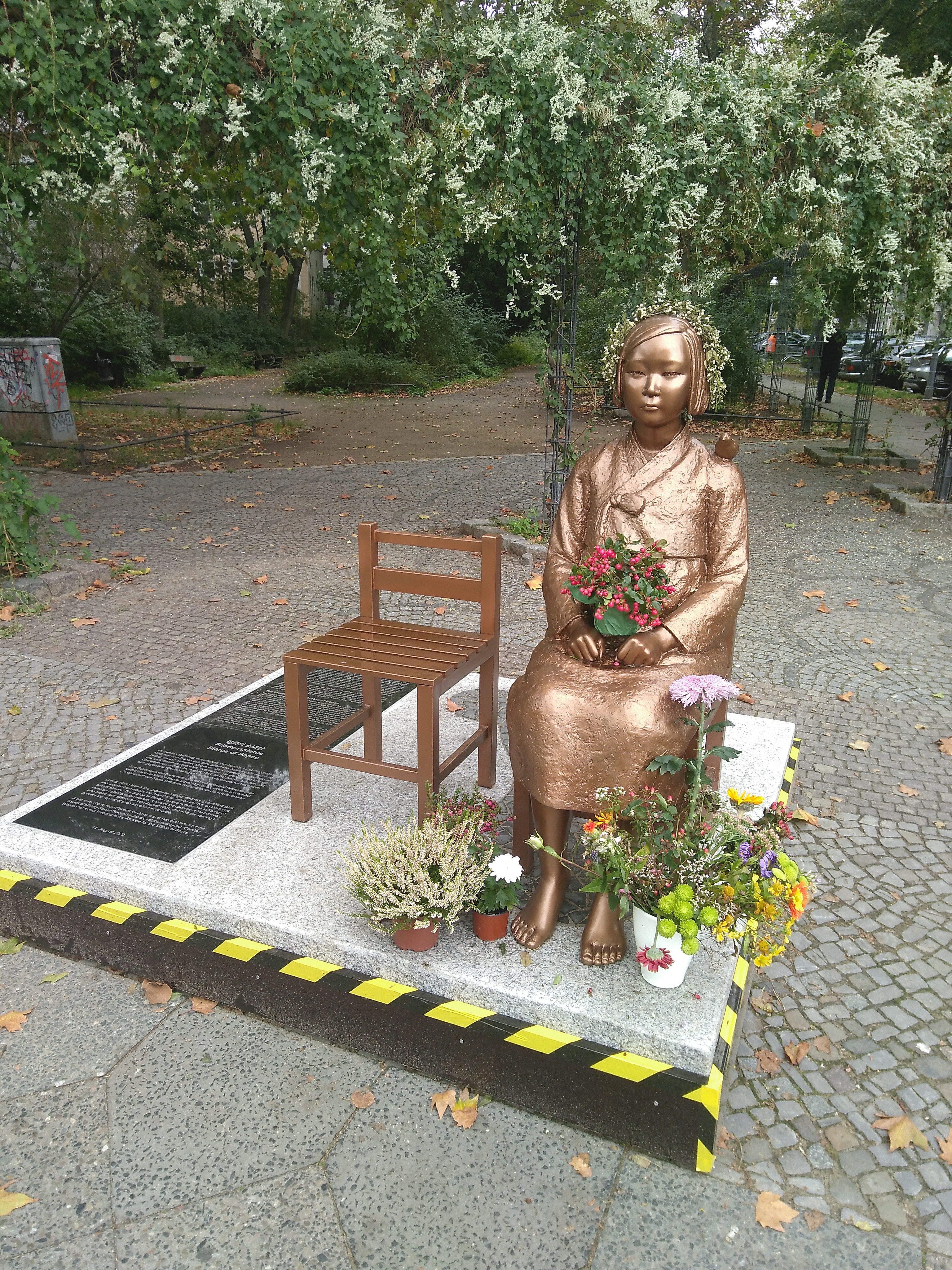
The Peace Girl statue in Mitte, Berlin, granted permanent status in 2022 after Japanese diplomatic pressure failed to secure its removal.
The survivors who led the way
The women who spoke were not professional activists. They were grandmothers who had carried a secret for decades — and chose, in the final chapters of their lives, to risk shame and misunderstanding to tell the truth. Their courage deserves to be named.
- — Kim Hak-soon (1924–1997) — The first survivor to speak publicly, August 14, 1991. Her testimony opened the door for hundreds of others.
- — Lee Yong-soo (b. 1928) — Has testified before the US Congress, UN, and European Parliament. Still active as of 2024, in her mid-90s.
- — Gil Won-ok (1926–2022) — Attended Wednesday Demonstrations for decades. Received the Seoul Human Rights Award in 2019.
- — Kim Bok-dong (1926–2019) — Spent her final years touring the world to speak about her experience. Donated her settlement money to other victims of wartime sexual violence.
What you can do
- → Learn and share. Most people outside Korea and Japan have never heard of comfort women. Share this page. Talk about it. The issue survives on attention.
- → Watch and read. The documentary The Apology (2016, dir. Tiffany Hsiung) follows three surviving comfort women. Yoshimi Yoshiaki's book Comfort Women (1995) is the essential scholarly history.
- → Support survivor organizations. The Korean Council for Justice and Remembrance continues to advocate, document testimony, and support survivors and their families.
- → Attend or support the Wednesday Demonstration. If you are in Seoul on a Wednesday, you can attend. If you are not, you can follow and amplify the demonstration online.
- → Contact your government. Ask your elected representatives to support international pressure on Japan for a formal, legally binding apology and reparations.
Organizations
- Korean Council for Justice and Remembrance womenandwar.net
- House of Sharing (나눔의 집) nanum.org
- Amnesty International — Comfort Women Campaign amnesty.org
- Human Rights Watch — Japan/Korea hrw.org
- The Apology — documentary theapologydoc.com